trip info
-
Min 1 Max 12
-
Grade: Challenging
-
Mar-May, Sep-Nov
-
Max. 5,357m/17,575ft.
-
Duration: 16 Days
-
Private Vehicle/ Flights
-
Hotel/ Teahouse/ Lodge
-
All meals are included
<strong>Who we are</strong> Our website address is: <a href="http://www.alpinetrav.com" target="_new" rel="noopener">http://www.alpinetrav.com</a>. <hr /> <strong>What personal data we collect and why we collect it</strong> <h3>Plugin Data Collection and Compliance</h3> This website uses plugins that may store personal information. These plugins comply with GDPR regulations and are designed to manage and protect your data securely. Below are details on what data may be collected and why: <ol> <li><strong>Contact Forms</strong> <ul> <li>When you use contact forms, the plugin may collect your name, email, and other necessary details to provide responses to your inquiries.</li> <li>This data is stored to enable us to respond to your messages effectively and is retained only as long as necessary for communication.</li> </ul> </li> <li><strong>Comments and Spam Detection</strong> <ul> <li>Comments on the site collect data shown in the form, as well as the visitor’s IP address and browser user agent string to assist in spam detection.</li> <li>This data may also be shared with an automated spam detection service.</li> </ul> </li> <li><strong>Cookies and Data Storage</strong> <ul> <li>Some plugins may set cookies to improve user experience, such as storing login information or remembering preferences. These cookies comply with GDPR standards and expire after a set period or upon logging out.</li> <li>Cookies specifically used by these plugins do not collect personal data unless explicitly mentioned.</li> </ul> </li> <li><strong>Embedded Content</strong> <ul> <li>Embedded content from third-party websites may behave as if the visitor has visited those external websites. These third-party sites might collect data and track your interaction as per their policies.</li> </ul> </li> <li><strong>Analytics</strong> <ul> <li>Some plugins may collect anonymous analytics to improve site performance. However, no personal information is stored unless explicitly noted, and all data complies with GDPR standards.</li> </ul> </li> </ol> <h3>How Long We Retain Your Data</h3> The collected data is stored only as long as necessary for the intended purposes, such as for communication or to improve the site experience. This may vary based on the plugin and specific regulatory requirements. <h3>What Rights You Have Over Your Data</h3> Under GDPR, you have the right to: <ul> <li>Access: Request a copy of the personal data we hold.</li> <li>Rectification: Correct any data we hold about you that is incorrect.</li> <li>Erasure: Request the deletion of your data, provided it is no longer necessary for regulatory or operational purposes.</li> </ul> For requests, please contact us using the information in our Contact section below. <hr /> <strong>Where We Send Your Data</strong> Visitor comments may be checked through an automated spam detection service. Some plugins may also send anonymized data to third parties as part of analytics or performance monitoring. <strong>How We Protect Your Data</strong> All data managed by this website and its plugins is stored securely. We ensure our plugins meet industry standards for encryption and data protection. We also regularly update our website to prevent unauthorized access.
Highlights of the Gokyo Lake and Renjo La Pass Trek
- Begin your journey with an exciting flight to Tenzing Hillary Airport, which offers a bird’ s-eye view of the Himalayas.
- Walk through Sagarmtha National Park, a UNESCO heritage site, witness diverse flora and fauna, and cross several suspension bridges.
- Witness stunning views of the towering mountain peaks, glaciers, and valleys.
- Navigate one of the challenging passes, Renjo La, and reach the iconic landmark, Gokyo Ri.
- Explore the scenic village of Gokyo and the stunning turquoise Gokyo Lakes.
- Get a close-up view of the iconic mountain peaks of the Khumbu Valley, including Mount Everest, Makalu, Cho Oyu, and other surrounding peaks.
- Witness the world’s largest glacier, Ngozumpa, flowing from Mount Cho Oyu.
- Capture a mesmerizing close-up view of the sunrise over Mount Everest from Kalapatthar.
The Gokyo and Renjo Pass Trek is a breathtaking adventure that promises awe-inspiring landscapes, tranquil turquoise lakes, and panoramic views of some of the world’s highest peaks, including Everest. This trek is a less crowded alternative to the more popular Everest Base Camp Trek that takes you to the Gokyo Fifth Lakes and over the stunning Renjo Pass, offering spectacular views of Everest and other Himalayan giants.
The Gokyo and Renjo Pass Trek perfectly blends adventure, natural beauty, and cultural immersion, offering a more serene and peaceful experience. If you wish to experience trekking in the Everest region while avoiding the busy trails and ensuring you have the best views, cultural experiences, and visits to major attractions, then this trip is perfect for you. Likewise, this trek is ideal for those new to high-altitude trekking but still want to experience the thrill of the Himalayas.
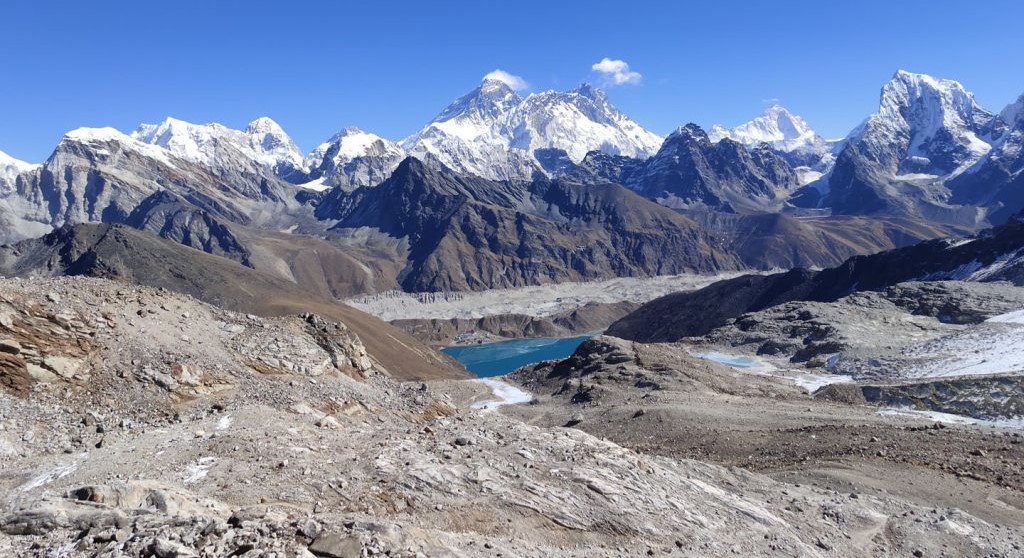
The highlight of the journey is Gokyo Ri (5,340m) and Renjo Pass (5,360m), which both provide an awe-inspiring panorama of Everest and nearby peaks and the beautiful Gokyo lakes alongside Ngozomba Glacier. From the top of Gokyo Ri and Renjo Pass, you will be treated to panoramic views of some of the world’s highest peaks, including Everest (8,848m), Lhotse (8,516m), Makalu (8,485m), and Cho Oyu (8,188m). The sight of these towering giants, set against the backdrop of a clear blue sky, is a sight that will stay with you forever.
However; The Gokyo and Renjo Pass follow the scenic route through the Khumbu Valley. Starting with a flight from Kathmandu to Lukla, the route follows the trail to Gokyo. It then crosse the Renjo La Pass and return to Lukla via Lungden, Thame, and Namche Bazaar. Then, Kathmandu.
Customize Your Gokyo & Renjo La Trek:
- This is a general itinerary, which can always individually be “tailormade”. The Gokyo and Renjo La trek package can be redesigned or redeveloped as per your taste, For more information please contact us.
16 Days Gokyo Lake and Renjo La Trek Itinerary
We recommend that you schedule your arrival in Kathmandu in the morning or afternoon. This will give you enough time to relax and recover from jet lag before starting your adventure. Upon arrival at Kathmandu International Airport, our representative will meet you at the airport and transfer you to your hotel where you will be served welcome drinks. After you have freshened up, your trek guide will brief you about your trip in the lobby of your hotel in the evening.
Get familiar with your surroundings by taking a walk down the street. Visit to Thamel, the main tourist hub. Overnight at Kathmandu's in a Hotel.
Accommodation: Hotel Moonlight
During the 35-minute flight from Kathmandu to Lukla (9,186ft), you will enjoy one of the most beautiful air routes in the world culminating on a hillside surrounded by high mountainous peaks. At Lukla, a gateway destination from where your trek begins, you will meet your other crew members and begin packing and arranging with them. From Lukla, you will start trekking. At one hour’s gradual descent, you will be at a Cheplung village from where you have a glimpse of Mt. Khumbila (18900 ft), a sacred mountain which has never been climbed. From Cheplung, you will gradually descend until you will reach Phakding and spend the night.
Accommodation: Teahouse/Lodge
Meals: Breakfast, Lunch and Dinner
Walking through a beautiful pine forest, you will follow the trail north up the valley of Benkar. You will cross Dudh Koshi River and go on passing Chumoa to Monjo, the entrance to Everest National Park. Then after crossing a suspension bridge, you will pass Jorsale village and walk alongside of the Dudh Koshi and Bhote Koshi rivers. A steep ascent brings you to the prime heartland of Sherpa village – Namche Bazaar. At one hour’s distance to reaching Namche Bazaar, if the weather permits, you can view the sights of Mt. Everest and Mt. Lhotse. Stay overnight at Namche Bazaar.
Accommodation: Teahouse/Lodge
Meals: Breakfast, Lunch and Dinner
There are plenty of things to do around Namche Bazaar, and you can spend a day here acclimatizing. Namche Bazaar is the main centre of the Khumbu region and has government offices, ATMs, Internet cafes, shops, restaurants, and a colorful market. Your guides can take you to explore the real charm of Namche Bazaar. Hiking to Sagarmatha National Park rewards trekkers with a sunrise view and the views of Mount Everest, Lhotse, Nuptse, Ama Dablam, Thamserku, Kongde and so on. If you are interested in a day hike, you will trek to Khumjung village (12401 ft)-a beautiful village with a Sherpa settlement. In exploring Namche Bazar, you will observe traditional Sherpa life, Khumjung Hillary School, and enjoy flora and fauna found at such altitude. Stay overnight at Namche Bazaar.
Accommodation: Teahouse/Lodge
Meals: Breakfast, Lunch and Dinner
Today, you will continue your trek from Namche Bazaar towards Dole, enjoying a picturesque traverse through various points such as Dudh Koshi, stupas, and iconic peaks like Mount Ama Dablam, Lhotse, Thamserku, and Everest, among others. Keep your eyes open, as you may have the opportunity to see Musk Deer and Himalayan Tahrs on the way. After approximately two hours of walking, you will reach Mong La Pass. Where,you will take a brief rest and continue your trek, passing through rhododendron forests and small Sherpa villages. The trail gradually ascends, with steep sections. Along the way, you will pass through the small village of Phortse Thanga. You will continue trekking until you willl reach Dole. Tonight, you will spend the night in Dole.
Accommodation: Teahouse/Lodge
Meals: Breakfast, Lunch and Dinner
The trek from Dole starts with a tricky downhill walk on a slippery, snow-covered slope. Then, you will climb steadily along a path with nice views of mountains like Mt. Cho Oyu, Mt. Kantega, and Mt. Thamserku. The uphill part of the walk takes you through areas with fewer plants and more rocky ground. You will pass by a small place called Lhafarma, then reach Luza village nestled in a side valley. After Luza, you will cross the Dudh Koshi River and walk on sandy paths where you will reach Machhermo village, the last big village before Gokyo. At Machhermo, you can visit the Himalayan Rescue Hospital to learn about altitude sickness. You will spend the night in Machhermo.
Accommodation: Teahouse/Lodge
Meals: Breakfast, Lunch and Dinner
You are approaching an altitude of 4500m, so you stayed an extra day at Machhermo to acclimatize by getting your bodies used to the thin air as you climbed up. There are plenty of outlets for exploration around the camp, and just above the village, there is a gracious vista that encircles Cho Oyu at [8210m] and the mountains that flank the Ngozumpa Glacier.
Accommodation: Teahouse/ Lodge
Meals: Breakfast, Lunch, Dinner
You will start trek today by climbing a ridge for an excellent view down the valley to Kangtaiga and also up towards Cho Oyu (8153m). The valley now widens as the trail passes through Phangkha, where an avalanche in 1995 killed 40 people. You will descend to the riverbank before climbing onto the terminal moraine of the Ngazumpa Glacier on a steep trail. Upon crossing an iron bridge over a stream, the trail levels out as it follows the valley past the first lake, known as Longpongo, at 4690m. At this juncture, you get a chance to observe lama footprints on a stone. At the sight of the second lake, Taboche Tsho, you will become mesmerized by the shimmering turquoise blue sheet of water sparkling in the sun. Little ahead of the second lake, you will reach the third lake, the two linked by a surging stream. Gokyo village stands by the third lake and Cho-Oyu Mountain as a backdrop sets an amazing spectacular sight here. After lunch, you will explore around the third lake, Dudh Pokhari. Overnight in Gokyo.
Accommodation: Teahouse/Lodge
Meals: Breakfast, Lunch and Dinner
You will hike to Gokyo Ri, a small peak above Gokyo village, in the morning and savor the fantastic views of the entire Khumbu region. As you will ascend, the views become even more fantastic and you can see four of the seven highest peaks of Nepal, Cho Oyu, Everest, Lhotse and Makalu. Reaching the fourth lake, Thonak Tsho you will take pleasure in the lake’s serene beauty after which your trek back along the retracing trail to the third lake. You will may take an additional hike up to the fifth lake, Ngozumba Tsho if time permits and depending on your physical conditions. From here, the view of Ngozumba glacier, the longest glacier of the Himalayas, is so fascinating. Overnight in Gokyo.
Accommodation: Teahouse/Lodge
Meals: Breakfast, Lunch and Dinner
Today, you will start the day early in the morning to complete the long day’s trek ahead. Your trail moves alongside Dudh Pokhari (lake) for a while. You will walk for around two hours before descending towards the Renjo La pass. On the way you are rewarded with extravagant views of the Himalayan and Rolwaling ranges and others. Views from the Renjo La pass are much like that from Gokyo Ri with the third Gokyo Lake and Gokyo Village beneath the gray smear of the Ngozumpa Glacier. You will also get outstanding views of Mt. Everest from the top of the pass. Continuing on from the pass, your trail winds down a stone staircase and then moves over a loose scree to reach the south bank of Angladumba Tsho Lake. The prescence of ice on the trail while descending down can make your descent a bit hazardous. Along the way you will see Relama Tsho and Renjo Lake. You will walk down a narrow valley clogged with giant boulders to Lumde where you will stay overnight.
Accommodation: Teahouse/Lodge
Meals: Breakfast, Lunch and Dinner
The trail from Lungden to Thame is a gentle descent, passing through traditional Sherpa villages and ancient monasteries. At an altitude of 3,820 meters, Thame is one of the oldest Sherpa settlements in the region. Explore the village and visit the Thame Monastery, a mountain spiritual haven.
Accommodation: Teahouse/Lodge
Meals: Breakfast, Lunch and Dinner
You will continue along the same trail to Namche Bazar, passing through pasture land and remote territory with splendid views. This downhill section offers a breathtaking view of Mount Kongde Ri, Thamserku, and Kusum Kangaru. You'll cross several suspension bridges over the Bhote Koshi River while enjoying the view of lush rhododendron forests, and you'll reach Namche Bazaar. You have lunch at Namche and begin your descent, continuing your trek to Monjo.
Accommodation: Teahouse/Lodge
Meals: Breakfast, Lunch and Dinner
Today your last day of the trek follows the Dudh Kosi River down to Lukla. From Monjo, you'll gradually walk along the Dudhkhosi river. You’ll have lunch on the way and make the final climb up to the airstrip at Lukla. The rest of the day is free, and you can relax under the warm sun & reflect on the emotional experiences you had while hiking through these massive mountains that have probably helped you're-discover your selves in ways you'll least expected. This is your final day in these fantastic mountains. Later, you'll celebrate your successful trek completion with your Sherpa guides and porters, whom you’ve gotten to know so well & are now good friends. It’s a pleasure to end this wonderful trip on a happy note. You'll then slumber into blissful sleep.
Accommodation: Teahouse/Lodge
Meals: Breakfast, Lunch and Dinner
After breakfast, you will take a scenic morning flight from Lukla to Kathmandu, which will be the end of your incredible 14-days Gokyo Lakes and Renjo La Pass Trek. Enjoy the aerial view of the Himalayan peaks and lush valleys as you bid farewell to the Everest region. Upon arrival in Kathmandu, you will be transferred to your hotel, where you can relax or explore the city’s vibrant streets and markets. Overnight in Kathmandu.
Accommodation: Hotel Moonlight
Meals: Breakfast
Today is your free day in Kathmandu. On this day, you can rest, explore, and shop. No activities are scheduled for today, as it’s your free day. Likewise, the day also serves as a contingency day in case of any flight delays. Additionally, if you want to include any activities for the day, feel free to let us know. Overnight at Kathmandu.
Accommodation: Hotel Moonlight
Meals: Breakfast
Thank you for joining us on this trek and it has been a pleasure getting to know you during this time. We hope this venture has enriched your experience with happy memories. You will be assisted in your last minute preparation. Our representative will take you to Tribhuvan International Airport three hours before your scheduled flight. Bon voyage for a safe and pleasant trip home. Safe Journey!! We hope to see you again.
Meals: Breakfast
Gokyo & Renjo La Trek - 16 Days Cost Details
Cost Includes
- Twin-share accommodation at Hotel Moonlight in Kathmandu for 3 nights
- Accommodation with private bathroom at Phakding, Namche and Lukla
- Cozy accommodation with shared bathroom at other places
- All meals (Breakfast, Lunch and Dinner) during the trek
- Tea/ Coffee with Hot boiled water for drinking purposes on the trek
- Kathmandu – Lukla airfare with 20kgs baggage allowance
- Lukla – Kathmandu airfare with 20kgs baggage alllowance
- International Airport Pickup and Drop as per your flight time
- Other transportation as per itinerary on tourist vehicle
- Sagarmatha (Everest), National Park Permit Fees
- Khumbu Pasang Lhamu Rural Municipality Entry Fee
- Experienced English speaking local trekking guide
- Assistant guide to client ratio for personalized attention and support
- 1 porter for every 2 trekkers: Porterage of your duffel bag (15kgs)
- Duffle bag for porter use (1 duffel bag per trekker)
- Comprehensive first aid kit with high altitude medicine
- Trekking Area Map, and Water Purifications Tablet
- Staffs salary, food, equipment, and insurance, included on-trip cost
- Official expense, all local and government tax and VAT.
- Sleeping bag if needed (it is refundable)
Cost Excludes
- International flight tickets and Nepal entry visa fee
- Lunch and Dinner in Kathmandu during stay
- Disembarkation Airport Tax in Nepal - approx. US$ 24. al equipment
- Personal hiking equipment
- Personal expenses. Additional expenses due to unforeseen circumstances such as other events beyond control.
- Drinks except tea and coffee. (Bar Bill, laundry and telephone calls.)
- Travel Insurance: Liability of insurance against any kind of medical expenses etc.)
- Emergency rescue evacuation if needed
- Tips for treks guide and porter (it is appreciated)
16-Days Trip Cost Details
- The trip cost always depends on group size, hotel accommodation category and client’s desire budget
- The included itinerary is a guideline and standard pattern which AlpineTrav you. This trip itinerary can be modified according to your time and requirements
- The itinerary shall be changed after an understanding between both AlpineTrav and the client. Additional activities could be either added or reduced as per client’s request before the trip confirmation
- Price shall be adjusted in our mutual understanding, if the client intends to add some services we shall charge him/ her for those additional services and if he/she intends to lessen some services, we shall wave the charges accordingly
- The Gokyo and Renjo Pass Trek itinerary has been published in 3-star hotel and tea house/lodge services for better understanding of the customers.
Please contact us on WhatsApp: +9779860751012 for any information about in your selected package.
Useful Info
Please take care to note: Every effort will be made to keep to the above itinerary; however, since this adventure entails traveling in remote mountainous regions, we cannot guarantee that we will not deviate from it. Weather, the health condition of a group member, unexpected natural disasters, etc., can all contribute to changes in the itinerary. The trek guide will try to ensure that the trip runs according to plan, but please be prepared to be flexible if required.
Accommodation at Everest Region, During the Trek
Comfortable Stays in Cities and on the Trail Your comfort is our priority, whether in the bustling city or the serene mountains: In Kathmandu: Stay at Hotel Moonlight or a similar hotel, offering modern amenities for a relaxing experience(Room Arrangement: are on a twin-sharing basis, and during the trek stay in teahouse/lodge, known for their warmth and hospitality.
Accommodation at during trek: Twin-sharing accommodation with private bathroom at Phakding, Namche Bazaar and Lukla – Then – Twin-sharing accommodation with shared bathroom at other places
Meals at Everest Region, During the Trek
During the trek, meals are typically served in teahouses, offering a variety of Nepali and international dishes. Which you can enjoy authentic Nepalese food as well the more common international cuisine (Tibetan, Continental, Italian, Indian, etc.).
- Breakfast and Dinner (On OPEN/CHOICE Menu) Served at the teahouse where you will spend the night.
- Lunch: Provided en route to the next destination, offering flexibility to enjoy the day’s journey.
- Special Touch: Breakfasts are provided your stay in Kathmandu you will also enjoy a specially prepared farewell dinner to celebrate the end of the trek.
Typical day on during the trek
Daily wake up calls will be between 6.00 am to 7.00 am while on the trek. The wake-up time and breakfast time will be decided a night before during the briefing time. The time table for each day will entirely depend on your walking duration for that particular day.
After breakfast, you set off on the day’s walk. Before breakfast, you are required to pack your duffel bag as it will be loaded by the porter while you are having your breakfast. Then you few hrs walkimg and you will stop for lunch mid-day. The afternoon’s walk is generally shorter and you’ll usually arrive at your destination in time for afternoon tea.
Details of Gokyo Lake and Renjo La Pass Trek
Gokyo Lakes – Located at an elevation of 4,700–5,000 m (15,400–16,400 ft), Gokyo Lakes is one of the prominent landmarks of the Everest region. It is one of the highest freshwater lake systems, with six lakes, and it was named after the Gokyo Ri. The lakes lie in the Khumjung Village Development Committee within the Sagarmatha National Park and have also been designated a Ramsar site. The Gokyo Lakes have a surface area of 196.2 ha (485 acres). Each lake of Gokyo is surrounded by towering peaks, adding to the beauty of the lakes. Moreover, Gokyo Cho, also called Dudh Pokhari, is the main lake, which is more famous and has an area of 42.9 ha (106 acres).
Renjo La Pass – Renjo La Pass, at 5,360m/ 17,585ft, is one of the three high passes in the Everest region. It lies in the westernmost of Nepal’s Three Passes within the Sagarmatha National Park. Likewise, the pass connects the Gokyo Lakes area to the western valley.
On the journey to Gokyo Lakes and Renjo Pass, the pass is one of the challenging sections featuring high elevation, steep and rocky terrain, and unpredictable weather. In addition, Renjo la Pass offers views of the Everest massif, including Mount Everest, Lhotse, Cho Oyu, Ama Dablam, and other surrounding peaks.
View of Gokyo Lake and Renjo La Pass Trek
The Gokyo Lakes and Renjo La Pass Trek is a stunning journey that offers trekkers the majesty of the Khumbu region. From the start to the end of the journey, trekkers will be amazed by the exceptional views, with each step showcasing the region’s diverse landscape and beauty. One of the key views of the trek is Gokyo Lake, a set of six turquoise lakes surrounded by towering peaks. Likewise, the view of Mount Everest, Lhotse, Makalu, Cho Oyu, Ama Dablam, Nuptse, and other surrounding peaks accompanies the trekkers all along the trek.
Furthermore, it offers a view of the mixed terrain of the Sagarmatha National Park, from glaciers to valleys and forests. Excluding the beauty of nature, the trek presents chances to witness the Sherpa culture, tradition, and religious hub. In addition, Gokyo Ri and Renjo La Pass are two prominent landmarks along the trek, offering stunning views of mountains, glaciers, and other nature’s majesty.
Altitude sickness and adaptation
The Gokyo Lakes and Renjo Pass Trek involves a significant risk of altitude sickness, especially if proper acclimatization is not followed. As the trek begins from an elevation above 3,000m and reaches above 5,000m, the risk of altitude sickness is high throughout the trek, requiring a proper acclimatization plan. Thus, AlpineTrav Treks & Expedition’s package ensures an appropriate itinerary with an acclimatization plan to keep trekkers safe and away from the risks related to altitude sickness.
The trip package involves acclimatization at key locations, including Namche Bazaar (3,440m), Machermo (4,470m), and Gokyo Village (4,750m). The acclimatization days are not only about resting and sleeping; instead, they follow the rule of “climb high, sleep low,” which means trekkers hike to higher elevations as a day hike and sleep at the lower elevation. This helps trekkers get used to higher altitudes and temperatures while acclimating at high elevations.
Training for Renjo La Pass Trekking
As Renjo La Pass is one of the most challenging treks in Himalayas, trekkers should train properly to navigate the section on the journey to Gokyo Lakes with Renjo Pass. Thus, trekkers planning the trek should prepare themselves with cardiovascular training, flexibility, mobility training, and strength training 2-3 months before the trek.
Cardiovascular Training
- Start practicing hiking on rugged trails with a backpack.
- Involve running and jogging 3-5 times a week to improve stamina.
- Cycling is best for endurance and leg strength.
- To be prepared for steep ascents, practice stair climbing.
Strength Training
- Focus on leg exercises by including squats, lunges, calf raises, and step-ups.
- Focus on core workouts like planks, sit-ups, and Russian twists that help stability.
- Focus on push-ups and shoulder presses for upper body strength.
Flexibility and Mobility Training
- Involve in yoga as it enhances balance and helps control breathing.
- Practice stretching by focusing on the legs, hips, and back.
How much does a Gokyo and Renjo Pass trekking cost?
The cost of a Goyo Lake and Renjo Pass trekking depends on the travel preferences and duration of the trek. Factors that affect these costs are accommodation, transportation, permits, guides, porters, and duration of the trek. So before purchasing the price, check the inclusions and exclusions section mentioned above. Our 16-day trek costs USD 1,870 per person, which is an all-inclusive cost. In addition, a group discount is also available for the trek, if you are in a larger group, feel free to contact us for trip cost and availability.
The cost covers lodging in Kathmandu and throughout the trek, meals, permits, domestic flights, a trekking guide, a porter, all ground transportation. This all-inclusive cost ensures trekkers are worry-free and only focus on the journey rather than the logistics.
Permits for Gokyo Lake and Renjo La Pass Trek
The Sagarmatha National Park Entry Permit and the Khumbu Pasang Lhamu Rural Municipality Entrance Permit are necessary to trek to Gokyo Lake and Renjo La Pass. The Nepal Tourism Board (NTB) and the Trekking Agencies Association of Nepal (TAAN) have implemented the permits, so obtaining them is necessary.
Sagaramtha National Park permit – Trekkers can obtain a Sagaramtha National Park permit from the Nepal Tourism Board in Kathmandu or Monjo. The permit costs NPR 3000 for foreigners and NPR 1500 for SAARC citizens. It is necessary to support the park’s conservation and maintenance and monitor trekkers throughout the area.
Municipality Entrance Permit – The Khumbu Pasang Lhamu Rural Municipality Entrance Permit is a newly introduced one to replace the TIMS (Trekkers’ Information Management System) card. It is available at the Monjo checkpost and in Lukla and costs NPR 2000 for everyone for the first four weeks, then NPR 2,500 per person after four weeks. The permit is necessary because it helps manage local tourism and supports infrastructure development in the Khumbu region.
Best time to Gokyo Lake and Renjo Pass trek
Spring and Autumn are the two best times for the trek to Gokyo Lakes and Renjo Pass. From March to May, spring comes after the coldest season and before the monsoon season. Winter and Autumn, from September to November, come after the monsoon season and before winter. The seasons are best for the trek due to the ideal trekking conditions they provide. Likewise, the weather and temperature are pleasant and stable during spring, ranging from –10°C to 15°C, and Autumn, ranging from -12°C to 15°C, making them the best for trekking.
The challenge of Gokyo Lake and Renjo Pass
The trek to Gokyo Lakes via Renjo Pass is undoubtedly a breathtaking journey in the Everest region. However, the trek isn’t without challenges, adding to the thrill and difficulty of the trip. The major challenge of the Gokyo Lakes and Renjo Pass Trek is the high altitude, which poses the risk of altitude sickness. The trek reaches up to an elevation of 5,360m/ 17,585ft, with a high risk of acute mountain sickness.
The harsh weather of the Himalayas, with cold temperatures dropping below freezing at nighttime, adds to the challenge of the trek. Similarly, the sudden change in weather from strong winds to fog to sudden snowfall makes the trek more difficult. The steep and challenging terrain with loose rocks is another factor that makes the trek challenging. Moreover, crossing Renjo la Pass, Limited accommodation, long trekking destination, and potential ice formations section are other challenges of the Gokyo Lakes and Renjo Pass Trek.
Tips to Overcome Those Challenges
- Acclimatize properly and ascend slowly throughout the trip.
- Check the weather forecast regularly before starting the day’s trip. Be prepared to stay in a basic teahouse with limited accommodation and food choices.
- Train well for 2-3 months before the actual journey with cardio strength training and hiking practices.
- Stay hydrated and eat a proper, balanced diet throughout the trip.
- Wear appropriate gear, from warm layers to good trekking boots.
- Carry medication (diamox) that helps to reduce the risk of altitude sickness.
- Listen to your body and be aware of altitude sickness symptoms.
- Choose the right trekking season to avoid facing harsh weather.
- Book tea houses in advance if you are traveling in peak seasons.
- Carry snacks and energy bars for extra energy during the trek.
- Follow a slow and steady pace instead of rushing on the ascent.
- Carry a first aid box with the necessary items.
Detail information about flying into Lukla
Lukla Airport, also called Tenzing Hillary Airport, is one of the world’s most dangerous airports at 2,840 meters high serving as the entry and exit point for Everest region treks via flight. However, there are some operational changes involving flights from Ramechhap/Manthali airport at times.
Lukla flight from Ramechhap/Manthali Airport
Ramechhap/Manthali Airport is in Nepal’s Terai region, about a 5 to 6-hour drive from Kathmandu from there you’ll have a 20-minute flight to Lukla. In peak months such as March, April, May, October, and November, Lukla flights are redirected to Ramechhap/Manthali (474 m) due to increased air traffic.
Lukla flight from Kathmandu Airport
Similarly, in months like January, February, June, July, August, September, and December, Lukla flights originate from Kathmandu, which will take you about 35 minutes to reach Lukla. However, it is important to understand that the decision regarding the operation of Lukla flights is entirely up to the airlines and is influenced by the number of travelers each month.
Therefore, factors like unfavorable weather, airport congestion, runway issues, and geographical challenges often lead to flight delays or cancellations to Lukla. To account for this, it’s recommended to add an extra day or two to your Everest Trekking plan. This buffer time can be valuable in case of flight disruptions, ensuring you catch your scheduled international flight back home.
More inform about Lukla flight →
FAQs Related to Gokyo & Renjo La Pass Trek
It takes 15-17 days to complete the Gokyo Lakes and Renjo Pass trek, including the arrival, contingency, and departure days with the AlpineTrav Treks & Expedition. However, the itinerary is customizable, and trekkers can customize it according to their time availability and acclimatization needs.
The Renjo La pass differs from other passes in the Everest region in various aspects, from difficulty level to risk of altitude sickness to crowd level. While the Renjo La pass is moderate to challenging, other passes are the most difficult. Likewise, the Renjo La pass has less risk due to its gradual ascent from Gokyo, while other passes have a high risk. Moreover, Renjo La Pass is less crowded than other high passes in the region.
The Gokyo Lake and Renjo La Pass follow the scenic route through the Khumbu Valley. Starting with a flight from Kathmandu to Lukla, the route follows the trail to Gokyo. It then crosses the Renjo La Pass and returns to Lukla via Lungden, Thame, and Namche Bazaar. Then, it flies back to Kathmandu.
Yes, the Gokyo Lakes and Renjo La Pass Trek can be customized to include the Everest Base Camp (EBC). This customized itinerary involves more challenges but gives trekkers endless thrills. The customized itinerary includes trekking to Gokyo Lake on the first step, then trekking to Everest Base Camp via Chola Pass and returning via Renjo La Pass.
Yes, you can return via helicopter from Gokyo, and the option is faster and more comfortable. However, the helicopter return option can change the overall itinerary plan. Also, returning by helicopter is more expensive than trekking but offers a unique chance to witness the Everest region.
Snowfall depends on the trekking season to Gokyo Lake with Renjo Pas. Still, both Gokyo Village and Renjo La Pass lie at higher elevations, and snowfall can occur at any time. Yet, the likelihood of snowfall is high in the winter season due to the cold temperatures dropping below -20 degrees Celsius.
Yes, vegetarian and vegan options are available during the Gokyo Lakes trek. Due to the remote location and inaccessibility of roads and transportation, vegetarian and vegan options are most common. Similarly, it is better to eat a vegetarian option than a non-veg option because the meat items in the Himalayas are not fresh.
Yes, you need travel insurance for the Gokyo Lakes and Renjo Pass trek; in fact, it is highly recommended. The trek takes you to a remote high altitude and poses altitude-related issues. Buying travel insurance that covers high-altitude coverage, emergency evacuation coverage, and medical expenses coverage is essential.
Yes! The adventurous Everest region trek always relies on the weather conditions. Sometimes a flight gets postponed or even canceled due to unpredictable weather changes at frequent intervals. Kathmandu to Lukla is a 30-minute flight that lands at 2,840 meters / 9,318 feet airstrip at Tenzing Hillary Airport. Please be prepared accordingly with a few contingency days in case of cancelation of the domestic flights to and from Lukla.