

Trip Info
-
Min 1 Max 12
-
Grade: Challenging
-
Mar-May, Sep-Nov
-
Max. 5,545m/18,193ft
-
Duration: 18 Days
-
Private Vehicle / Flights
-
Hotel / Teahouse / Lodge
-
Meals Included (B,L,D)
<strong>Who we are</strong> Our website address is: <a href="http://www.alpinetrav.com" target="_new" rel="noopener">http://www.alpinetrav.com</a>. <hr /> <strong>What personal data we collect and why we collect it</strong> <h3>Plugin Data Collection and Compliance</h3> This website uses plugins that may store personal information. These plugins comply with GDPR regulations and are designed to manage and protect your data securely. Below are details on what data may be collected and why: <ol> <li><strong>Contact Forms</strong> <ul> <li>When you use contact forms, the plugin may collect your name, email, and other necessary details to provide responses to your inquiries.</li> <li>This data is stored to enable us to respond to your messages effectively and is retained only as long as necessary for communication.</li> </ul> </li> <li><strong>Comments and Spam Detection</strong> <ul> <li>Comments on the site collect data shown in the form, as well as the visitor’s IP address and browser user agent string to assist in spam detection.</li> <li>This data may also be shared with an automated spam detection service.</li> </ul> </li> <li><strong>Cookies and Data Storage</strong> <ul> <li>Some plugins may set cookies to improve user experience, such as storing login information or remembering preferences. These cookies comply with GDPR standards and expire after a set period or upon logging out.</li> <li>Cookies specifically used by these plugins do not collect personal data unless explicitly mentioned.</li> </ul> </li> <li><strong>Embedded Content</strong> <ul> <li>Embedded content from third-party websites may behave as if the visitor has visited those external websites. These third-party sites might collect data and track your interaction as per their policies.</li> </ul> </li> <li><strong>Analytics</strong> <ul> <li>Some plugins may collect anonymous analytics to improve site performance. However, no personal information is stored unless explicitly noted, and all data complies with GDPR standards.</li> </ul> </li> </ol> <h3>How Long We Retain Your Data</h3> The collected data is stored only as long as necessary for the intended purposes, such as for communication or to improve the site experience. This may vary based on the plugin and specific regulatory requirements. <h3>What Rights You Have Over Your Data</h3> Under GDPR, you have the right to: <ul> <li>Access: Request a copy of the personal data we hold.</li> <li>Rectification: Correct any data we hold about you that is incorrect.</li> <li>Erasure: Request the deletion of your data, provided it is no longer necessary for regulatory or operational purposes.</li> </ul> For requests, please contact us using the information in our Contact section below. <hr /> <strong>Where We Send Your Data</strong> Visitor comments may be checked through an automated spam detection service. Some plugins may also send anonymized data to third parties as part of analytics or performance monitoring. <strong>How We Protect Your Data</strong> All data managed by this website and its plugins is stored securely. We ensure our plugins meet industry standards for encryption and data protection. We also regularly update our website to prevent unauthorized access.
Mt. Everest Adventure Trek Highlights
- Enjoy a thrilling flight over clouds to Lukla.
- 18 days of pure adventure with a full support crew.
- Journey to the base camp of the world’s highest mountain and Kalapathar
- Trek via Phortse, a less trodden route
- Walk through the lively villages of legendary Sherpas.
- Appeal your eye with the majestic sight of Mount Everest, Makalu, Lhotse, Amadablam, Nuptse, Thamerku, Pumori, Lingten, Lhola, Tauche, Khangtenga, Cholatse, and other surrounding peaks.
- Witness jaw-dropping sunrises from Kalapatthar over the top of the world, Mount Everest.
- Visit a spiritual hub, the Tengboche and Pangboche monasters.
- Pass through the Sagarmatha National Park while witnessing diverse flora and fauna.
Everest Base Camp Trek is the most popular trek in Nepal’s 2,400km stretch of the Himalayas. It offers spectacular scenery, real Himalayan experiences, and the extraordinary culture of the Sherpa community while trekking the foothills of Mt. Everest. Experience the grandeur of Mount Everest [8,848m/29,029ft] up close, along with views of many other snow-capped mountains.
Trek to Everest Base Camp and Kalapathar on our 18-day itinerary, which has been carefully designed to ensure a well-paced walk, proper acclimatization, exploring the less trodden route via Phortse and covering all the major highlights of the Everest region. Our itinerary takes a unique approach through Phortse on the way up, offering a richer experience of the region and avoiding the repetition of trekking the same trail both ways. Our Everest Base Camp Trek is a fully guided and supported trek with lodge-based accommodation through out the trip.
The Mount Everest Base Camp trail goes over 5,000m/16,400ft for the last few days before reaching Everest Base Camp, but the trek isn’t as strenuous as imagined and does not require prior trekking experience while promising a fulfilling journey. Adding to the fun-filled Everest base camp trekking tour, the panoramic views of the Himalayas, monasteries, culture, and the mountain flight to Lukla are a few of the highlights of this trip.
Customize Your Trek:
- This is a general itinerary, which can always individually be “tailormade”. The trek package can be redesigned or redeveloped as per your taste, For more information please contact us.
18 Days Itinerary of Mt. Everest Adventure Trek
Upon arrival at Tribhuvan International Airport in Kathmandu, you’ll be warmly greeted by a representative of AlpineTrav. From there, you’ll be transferred to your hotel, where you can check in, freshen up, and relax after your journey. In the evening, enjoy a special welcome dinner hosted by AlpineTrav, offering a taste of Nepalese hospitality.
Accommodation: Hotel Vajra
Meals: (D)
In the morning, you visit two UNESCO World Heritage Sites, Boudhanath and Pashupatinath, as part of a guided sightseeing tour. The tour lasts approximately 3 to 4 hours. In the afternoon, you will be briefed about your upcoming adventure. If you have any doubts, check your equipment and visit the Swayambhunath Monkey Temple near your hotel. Spend the night in Kathmandu.
Accommodation: Hotel Vajra
Meals: (B)
Begin the day with an early morning scenic flight to Lukla, the gateway to all Everest treks. Upon arrival, meet the rest of the trekking team and start your journey. Follow a trail that gently descends to Cheplung Village, where you’ll catch a glimpse of Mt. Khumbila, a sacred peak that remains unclimbed. The trek continues with a gradual descent until you reach Phakding.
Accommodation: Teahouse/Lodge
Meals: (B,L,D)
Today, you will continue your journey along the Dudhkoshi River, which will take you through the pine forest. After crossing suspension bridges at several points and passing through the small settlements of Zapute, Toktok, Benkar, and Chumoa, you will reach Monjo. Ahead of Monjo is the entry to the Sagarmatha National Park, which is planned to look after and preserve the fragile mountain environment.
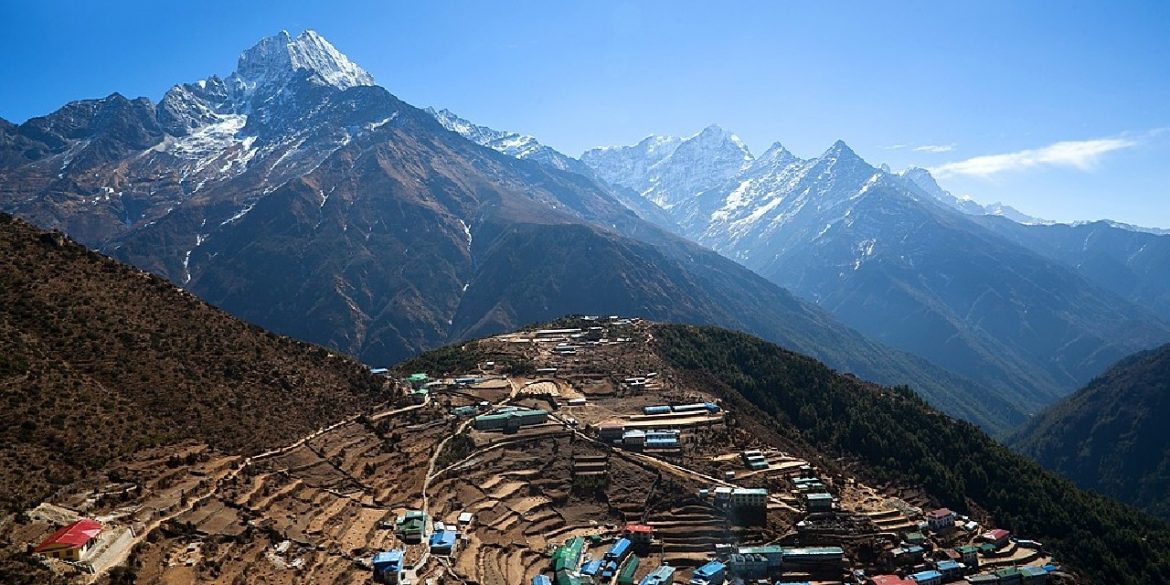
Lowering down from the park and crossing another suspension bridge, you will proceed towards the high Hillary Bridge located at the foot of the hill. Crossing this bridge, you will climb uphill to the Namche Bazaar. You can get a view of Thamserku Mountain. If the weather is clear, you can also have a first view of Mt. Everest, Lhotse, Nuptse, and the Kusum Khangru mountains.
Accommodation: Teahouse/Lodge
Meals: (B,L,D)
Today, you will stay an additional night in Namche to ensure proper acclimatization to the altitude. Namche, a prosperous village nestled in a large protected hollow, offers a chance to adjust to the higher elevation. After breakfast, you have a few options: you could hike up to the Everest View Hotel or a nearby viewpoint. Then return to Namche for lunch, and after, you’ll have free time to explore the bustling town of Namche Bazaar on the acclimatization day.
Accommodation: Teahouse/Lodge
Meals: (B,L,D)
After breakfast; from Namche, detour from the main trail and take on a less trodden route as we make our way to Phortse. Phortse is also a village popularly known as the summiteer’s village. This village alone holds the highest number of summiteers in the Everest region. There is also a newly built climbing center there in Phortse if you wish to visit.
Accommodation: Teahouse/Lodge
Meals: (B,L,D)
After breakfast, you hike through a few Chortens, mani walls, and some small villages, after which, you haul up for some grub and while enjoying your meals, you savour some upfront views of Amadablam towering just above you; Your trek via Pangboche, the highest of the true lasting settlements in the valley and reach the regular settlement, the final steepest climb of the day on your way to Dingboche. Agriculture is the chief occupation of locals in Dingboche. You can see fields enclosed by stonewalls in Dingboche. Buckwheat, potatoes, and barley are the major crops.
Accommodation: Teahouse/Lodge
Meals: (B,L,D)
Climb high and sleep low!! This is a day to haul up and rest without being idle. Your acclimatization gets a further boost with your hike to Nagartsang Peak [5,083m/16,625 ft], helping you prepare for the higher altitudes ahead. The climb may be tough, but reaching the summit is rewarding. Enjoy panoramic views of Ama Dablam, Island Peak, Lhotse, and other majestic peaks from the top. After taking in the stunning views, then retrace your steps back to Dingboche for a relaxing afternoon to rest and recover.
Accommodation: Teahouse/Lodge
Meals: (B,L,D)
Today’s trek takes you from Dingboche to Duglha, a short yet scenic journey offering incredible views of the Himalayan peaks. The trail ascends gradually, passing through the picturesque Imja Valley, surrounded by towering mountains like Ama Dablam, Lhotse, and Taboche. As you approach Duglha, you’ll notice the dramatic landscape changing to a more rugged and glacial terrain. The village of Duglha serves as a gateway to the Khumbu Glacier and offers an ideal stop to rest and acclimatize before continuing the trek to higher altitudes.
Accommodation: Teahouse/Lodge
Meals: (B,L,D)
The trek from Duglha to Lobuche is both challenging and rewarding, offering incredible views of the Himalayan peaks. The trail begins with a steep ascent to the Duglha Pass, where you’ll find a memorial site dedicated to climbers who lost their lives in the Everest region.
As you ascend, the landscape transforms into rugged glacial terrain, with stunning vistas of Mt. Pumori, Khumbutse, and the Khumbu Glacier. Upon reaching Lobuche, you’ll be surrounded by towering mountains, marking your proximity to Everest Base Camp. Overnight stay in Lobuche.
Accommodation: Teahouse/Lodge
Meals: (B,L,D)
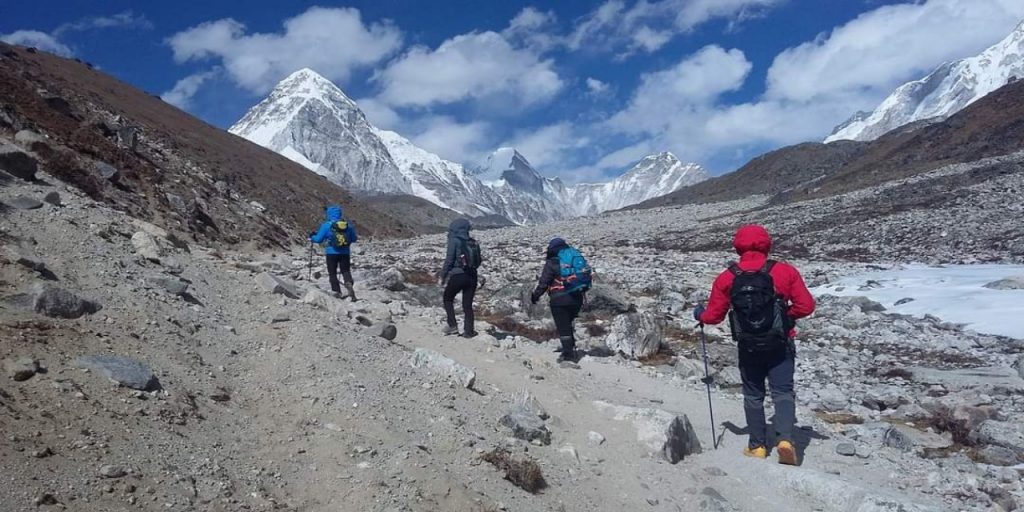
Begin your trek from Lobuche (4,940m/16,207ft), following a trail that weaves through rugged glacial moraines and offers mesmerizing views of the Himalayan peaks and the Khumbu Glacier. After 3 hours of walking, you’ll reach Gorak Shep (5,164m/16,942ft), the last settlement before Everest Base Camp. After a short rest and lunch, continue your journey to the legendary Everest Base Camp (5,364m/17,598ft). Walking along the glacial terrain, you’ll be surrounded by towering peaks, including Mt. Everest, Nuptse, and Khumbutse. Take in the awe-inspiring views and capture unforgettable moments at the base of the world’s highest mountain. Return to Gorak Shep for an overnight stay.
Accommodation: Teahouse/Lodge
Meals: (B,L,D)
Begin your day early with a hike to Kala Patthar (5,545m/18,192ft), one of the best viewpoints in the Everest region. The ascent is steep but short, taking around 2–3 hours. From the top, you’ll be rewarded with panoramic views of Mt. Everest, Nuptse, Lhotse, and Ama Dablam, along with the surrounding Himalayan peaks bathed in the golden light of sunrise. After soaking in the breathtaking scenery, descend to Gorak Shep for breakfast. From there, continue your trek downhill through glacial valleys and alpine landscapes, passing through Lobuche and Thukla, before reaching Pheriche (4,371m/14,340ft) for an overnight stay.
Accommodation: Teahouse/Lodge
Meals: (B,L,D)
Today you will start your trek downhill and interestingly, you will take a different route through the village of Pangboche. From Pangboche you will take a wonderful high pass above the Imja Drengkha River. The path meanders along the valley. You will be treated to spectacular views of the mountains and Tengboche on its banks. After about three hours, you will turn a corner and from Tengboche monastery you will follow a winding path through birch and rhododendron forests to Dudh Koshi. After crossing the river at the bridge, you will climb steadily uphill on a switch-backed path. Later, where you will soon reach a small group of lodges in Kyanjuma.
Accommodation: Teahouse/Lodge
Meals: (B,L,D)
In the morning after breakfast, you make your return trip on the same trail back to Namche. After lunch in Namche Bazaar you descend down to Monjo.
Accommodation: Teahouse/Lodge
Meals: (B,L,D)
After breakfast; from Monjo you continue your descent down the trail following the Dudh Koshi valley. This is along the same trail as you ascent and the villages you pass through will be familiar. At Chaurikharka you start the ascent of the final hill of the trek to reach Lukla. On arriving at Lodge you can enjoy your last evening with the guides and wonderful porters.
Accommodation: Lodge
Meals: (B,L,D)
After an early breakfast, you’ll head to Lukla airport for your flight out of the mountains. Depending on seasonal flight operations and weather conditions, you’ll either fly directly to Kathmandu or to Ramechhap. If flying to Ramechhap, a vehicle will be waiting for the drive back to Kathmandu, which takes about 5 hours. After arriving at Kathmandu, check in to your hotel, and the rest of the day is free to relax, enjoy a hot shower, or explore more of Kathmandu at your own pace.
Meals: (B)
A free day in Kathmandu to rest, explore, and shop. There are no activities scheduled for today. This day also serves as a contingency day in case of any delays with the flights. If you would like to do any sightseeing today, please reach out to us, and we can assist you with arranging sightseeing tours around Kathmandu.
Meals: (B)
Your incredible journey through the Everest region comes to an end today. After breakfast, our representative will transfer you to Tribhuvan International Airport for your final departure. Take with you unforgettable memories of the Himalayan adventure, stunning landscapes, and Sherpa culture. We wish you a safe journey and hope to welcome you back for another trek in the beautiful mountains of Nepal.
Meals: (B)
Follow the package's Inclusions and Exclusions.
Cost Includes
- All meals (B, L, D) on OPEN/CHOICE Menu whilst on a trek
- Twin-sharing accommodation at Hotel Vajra in Kathmandu for 4 nights
- Kathmandu/Ramechap – Lukla airfare with 20kgs baggage allowance
- Lukla – Kathmandu/Ramechap airfare with 20kgs baggage alllowance
- All private ground transportation including airport transfers
- Twin-sharing accommodation at cozy teahouses/lodges on the trek
- Sagarmatha National Park Permit Fees & Local Municipality Fee
- Experienced local trek guide with a 1:4 assistant guide-to-client ratio.
- Full support crew with 1 porter for every 2 trekkers
- Comprehensive first aid kit, oximeter with high altitude medicines.
- Use a Duffel bag and Sleeping bag (Must be returned completion of trek)
- Staff equipment, insurance, and allowances
- Arrangement of emergency helicopter service (paid from your travel insurance company).
- Office service charges and all government taxes.
- Farewell dinner in Kathmandu before departure.
Cost Excludes
- Meals: Lunch and Dinner in Kathmandu
- Personal transportation except above programs
- Personal trekking gears
- Personal Nature expenses. (Extra expenses incurred due to unforeseen circumstances such as sickness, accidents, road blockage, and other occurrences beyond our control.)
- Emergency evacuation (If incase)
- Drinks except tea and coffee. (Bar Bill, laundry and telephones calls.)
- Travel insurance. (Liability for insurance against sickness, accidents, loss of baggage, loss of life and medical expenses if any kind etc.)
- Emergency rescue evacuation if needed
- Purely personal nature expenses
- Tipping /Tips(Tipping is Expected).
Why didn't AlpineTrav Include the price in the package?
Price for the trip:
- The trip cost always depends on group size, hotel accommodation category and client’s desire budget
- The included itinerary is a guideline and standard pattern which AlpineTrav you. This trekking itinerary can be modified according to your time and requirements
- The itinerary shall be changed after an understanding between both AlpineTrav and the client. Additional activities could be either added or reduced as per client’s request before the trip confirmation
- Price shall be adjusted in our mutual understanding, if the client intends to add some services we shall charge him/ her for those additional services and if he/she intends to lessen some services, we shall wave the charges accordingly
- The itinerary is published in full board services for the better understanding to the client. Among many options such as hotel facilities in Kathmandu and Pokhara, the client can make his/her own choice
- The cost is also affected by the number of employees‒ guides and porters
- Please contact us for any information about in your selected package.
Nepal Visa Information
Visa on Arrival: Most nationalities can obtain a visa upon arrival at Tribhuwan International Airport in Kathmandu.
Visa Fees: A 15-day multiple-entry visa costs USD 30, a 30-day visa costs USD 50, and a 90-day visa costs USD 125.
Application Process: Visitors should fill out a visa application form, which is available online or at the airport, and provide a passport-sized photo and payment in cash.
Requirements: A valid passport with at least six months remaining validity and a blank page for the visa stamp is required. Ensure you carry sufficient USD cash for the visa fee as not all payment methods are accepted.
Food on Everest Adventure Trek
All meals will be provided during trekking while only breakfast will be available in Kathmandu. There will also be welcome and farewell dinners for guests. While on trek, you have breakfast and dinner in the lodges/teahouses you spend the night and lunch on your way to the next destination. Nepalese, Tibetan, the more common continental and Indian cuisines are common choices in the menu.
To get an idea about your meals on the go, breakfast comprises a hot beverage, toasts, pancakes, eggs, etc. while lunch will include rice items, noodles, potato varieties, pizza, pasta, burger, meat items, and so on. The starters in dinnertime are soup varieties while the main course includes more or less similar items as that of lunch menu, including a dessert item and a hot beverage. A detailed information about the food on the Everest Adventure trek gives you a clearer picture of your dietary provisions.
Is there any dietary advisory?
Meat is available at lodges during the trek, but we recommend choosing vegetarian meals once you’re above Namche. Meat in higher villages is often carried up from lower elevations and stored for extended periods without refrigeration, which can increase the risk of foodborne illness. Eating vegetarian food is generally the safer and healthier option at altitude.
Accommodation During Everest Adventure Trek
You will be accommodated in Hotel Vajra in Kathmandu; and lodges during the trek. All accommodations are on twin-shared basis. Single supplement will be served on request with an extra cost.
In trek; we will arrange rooms with attached washrooms; however, lodges in some places only have shared washing and toilet facilities. Also note that single rooms are readily available in Kathmandu and the trekking regions at lower elevation but it might be difficult to find them at higher elevations. The types and standards of accommodation during the Everest Adventure trek varies at different locations.
Will drinking water be provided on the trek?
Yes, we provide hot boiled water for drinking on the trek to minimize the use of single plastic bottles. Please bring a water bottle that can hold hot water, such as a Nalgene bottle. During meal times, we will refill your bottle with hot water. For added safety, you may also use water purification tablets or filtration devices.
Additional Information
Other information such as (Insurance, Arrival Instructions, Visa and Passport etc) required for the trip will be provided after your trip confirmation. Please feel free to get in touch with us if you require more information about the trip.
FAQs
To plan a trek and get off to a good start, it’s always a good idea to learn a little more about the area and even catch a few checkpoints. These FAQs will answer your most important question marks and provide tips to plan your trek with confidence. So, let’s get into them.
FAQs About Mt. Everest Adventure Trek
The trails on the Everest Adventure Trek are generally well-defined, following clear paths and yak trails. Some sections are narrow with slopes on one side, and the final two days involve uneven, rocky terrain near the Khumbu Glacier. No technical climbing is required.
The Everest Adventure trek does not involve extreme cliffs or highly exposed ridges like technical mountaineering routes, but there are some sections where the trail follows steep slopes with drop-offs but they are manageable with caution as the path is wide and well trodden.
The Everest Adventure trek has a very low risk of rockfall or landslides, especially in the pre- and post-monsoon seasons. Some areas, like Thukla Pass and Khumbu Glacier, have loose rocks, but incidents are rare. Sticking to established trails and trekking early in the day further minimizes any risk.
Yes, there are some steep sections, especially while ascending Namche Bazaar, Tengboche, and the final approach to Kala Patthar. However, these climbs are gradual and manageable with proper acclimatization.
The Everest Adventure Trek is generally safe for physically fit trekkers who follow proper acclimatization and guidance. The main risks are altitude sickness, slips on uneven or rocky trails, and harsh weather. With careful pacing, a knowledgeable guide, and adherence to safety precautions, the trek is manageable and rewarding.
Our Everest Adventure Trek itinerary has been carefully devised to ensure a well-paced walk, proper acclimatization, and to explore the less-trodden route via Phortse. Our Itinerary takes a unique approach through Phortse on the way up, offering a richer experience of the region and avoiding the repetition of trekking the same trail both ways.
To ensure proper acclimatization during the Everest Adventure trek, we spend two nights in Namche and two nights in Dingboche. These extended stays allow your body to gradually adjust to the higher altitudes and reduce the risk of altitude-related illnesses. During these days, you follow the proven “climb high, sleep low” principle. This means you ascend to a higher elevation during the day for a short hike or acclimatization walk, then return to a lower altitude to sleep. This approach helps your body adapt to thinner air, improving oxygen efficiency and minimizing symptoms of Acute Mountain Sickness (AMS). These carefully planned acclimatization stops are key to ensuring a safer and more enjoyable trek as you continue toward higher elevations.
A typical day on the trek starts with a wake-up around 6:00 am. Before breakfast, you should pack your duffel bag, which the porter will load while you enjoy your meal. After a hearty breakfast, you begin the day’s walk at around 08:00am. You usually stop for lunch after 3–4 hours of trekking. The afternoon walk is generally shorter, allowing you to reach your destination in time for afternoon tea. The rest of the afternoon is free. You can explore the village, wash your clothes, or relax with a book. (On some days)
You should expect to walk about 5–7 hours each day on the Everest Adventure Trek. The day we trek to Everest Base camp from Lobuche and return to Gorakshep is longer, around 10–12 hours. Similarly, the day we hike to Kalapathar in the morning and descend to Pheriche takes approximately 10 hours. On all other days, the trek involves 5–7 hours of walking on average at a steady pace.
Yes, the assistant guide sets the walking pace on the trek and the lead guide usually stays at the back to monitor the group and ensure everyone is coping welll. Depending on the group size, there will be assistant guides to set the pace and provide assistance for the team. The pace is slow and steady, suitable for most trekkers, allowing proper acclimatization and rest while ensuring safety and comfort throughout the trek.
The pace set by the assistant guide suits most trekkers. If someone is significantly slower, they will walk with an assistant guide separately, while the main group continues at a steady pace. This ensures everyone can trek safely and comfortably at their own speed.
Charging facilities are available at all the places on this trek. However, charging devices will incur additional costs. Additional costs typically range from Nepalese Rupees 800–1,500, depending on the device and location. At higher elevations, most lodges rely on solar power, so daytime charging may not always be possible, as they sometimes conserve energy for the evening.
Yes, Wi-Fi is available at most lodges along the Everest Adventure Trek. You can purchase Wi-Fi cards directly at the lodges, with costs varying from Rupees 1000 to 12000. Speeds may be slower at higher elevations due to limited connectivity, and service can be intermittent during bad weather or peak usage times.
Yes, hot showers are available at the lodges along the trek. They are included up to Namche Bazaar. Above Namche, hot showers usually cost around NPR 500. For the last two nights in Lobuche and Gorak Shep, showering is not recommended due to the extreme cold. Wet wipes are a convenient alternative for staying fresh.
All teahouse/ lodges also have small in-house shops or stores where you can buy essentials like bottled water, soft drinks, toilet paper, snacks, and energy bars. Prices tend to increase with altitude due to the effort required to transport goods, so it’s wise to bring some supplies from Kathmandu or stock up in lower villages like Namche.
Cell phone coverage in the Everest region is generally good, and internet access is available on most treks. You can buy a local SIM card in Kathmandu to stay connected; we recommend an NTC SIM for the best coverage on the Everest Adventure trek. Mobile networks provide good internet for a few days during the trek, but at higher altitudes, mobile networks do not support internet access.
The best seasons to trek to the Everest Adventure are Autumn (latter half of September till December) and Spring (latter half of March until mid-May). On both seasons, Mornings are usually clear, with clouds building up in the afternoon and disappearing at night. The given temperature may raise or lower with the change in weather factors: (Sunny, Snow, Rain etc.): The temperature during Autumn varies from the lowest -10 degrees Celsius at Gorekshep to warmest 25 degree Celsius at Lukla/Phakding.
The main difference between Spring and Autumn for trekking to Everest Adventure trek lies in weather conditions and the overall atmosphere. Spring, being the pre-monsoon season, is warmer with temperatures ranging from about -5°C to 20°C. Mornings are usually clear, but clouds often form during the day, and light rainfall is common. This is also the main climbing season for Mount Everest.
Autumn, on the other hand, is the post-monsoon season. The rains clear the skies, offering more stable and clearer weather with excellent visibility. However, temperatures are colder than in Spring, usually ranging from -10°C to 15°C. Both seasons are considered the best for trekking, but Spring offers a warmer climate and a bustling Adventure atmosphere, while Autumn provides clearer skies and quieter surroundings.
Yes, the Everest Adventure trek is possible in winter. However, you need to be prepared for much colder conditions, with night temperatures dropping as low as -20°C and evenings being very cold. Daytime temperatures are usually pleasant, making the trek manageable during daylight hours. December and January are generally good months for winter trekking as the weather is stable, but heavy snowfall is possible in February, so that month is not recommended.
Safety is at the core of everything we do. Our itineraries are carefully designed to ensure gradual acclimatization and minimize risk at high altitude. Before each trek, we conduct a detailed risk assessment to identify and prepare for any potential challenges. On the trail, you’ll be led by experienced guides—some of the best in the industry—who are trained to handle high-altitude situations with professionalism and care. In addition, we carry our own comprehensive medical kit.
We also maintain a high staff-to-client ratio, ensuring personalized support throughout the trek, whether you’re part of a small group or larger, we have the resources and contingency plans in place for any situation. During the busy trekking seasons, our team is stationed to assist swiftly with logistics or emergencies.
In case of emergencies, our team is available 24/7 to provide assistance with evacuation. We will coordinate with your insurance company and manage all rescue arrangements to ensure a timely and safe evacuation.
During the high season, health posts with doctors are stationed at Namche, Dingboche, and Pheriche. These posts provide first aid and immediate treatment for common trekking-related issues such as altitude sickness, minor injuries, and illnesses. They can stabilize patients and coordinate further care or evacuation if necessary.
If the weather is poor, all flights to Lukla for the day may be canceled. In the event of a flight cancellation, there are two main options:
Wait and try the next day:
If the flight is canceled, you will return to your hotel and attempt the flight the following day. Our itinerary is designed to accommodate such delays, so even if the flight is canceled for a day, the trek itself will remain unaffected, and your acclimatization schedule will not be compromised. Only the return itinerary may be adjusted to account for the delay, while the overall trekking plan stays the same.
Take a helicopter flight:
Helicopters can sometimes operate when planes cannot. If you choose this option, you will be responsible for additional costs, typically ranging from $300 to $500 or more, depending on factors such as the number of people sharing the flight, availability, and demand. This cost is calculated after crediting your plane fare.
If delays continue for several days and neither a helicopter nor a plane is available, we will collectively decide on the best course of action. This is especially relevant if delays occur before the trek begins, as the original itinerary may no longer be feasible. Your guide will assist throughout this process, and your understanding and cooperation are essential.
For this reason, it is important to include contingency days in Kathmandu after the trek to accommodate potential delays. If flights operate as scheduled with no cancellations, these extra days can be used for sightseeing in and around the Kathmandu Valley.
Yes, you can choose to take a helicopter flight from Kathmandu to Lukla or Lukla to Kathmandu instead of the plane flight. However, this option is available for private treks only.
Upon your arrival in Kathmandu, we will provide you with a duffel bag for repacking your trekking gear. You will need to repack your trekking gear into the provided duffel bag. You are allowed to take up to 15 kg in a duffel bag, and the duffel bag will be carried by the porter. Each porter is assigned to carry up to two duffel bags.
You can leave your luggage or any items you don’t need for the trek at your hotel in Kathmandu. After repacking your trekking gear into the duffel bag provided by us, the remaining luggage can be stored at the hotel at no additional cost.
Since most of your gear will be carried by a porter and you only need to carry essential items for the day, a 35–40 liter backpack is ideal for comfort and convenience.
Using a drone on the Everest Adventure trek is heavily regulated and often discouraged. You’ll need specific permits from the Civil Aviation Authority of Nepal, which are difficult to obtain and expensive. Additionally, many Sagarmatha National Park areas, including nearby monasteries and sensitive wildlife areas, have strict no-drone zones. Respecting local customs and minimizing disturbance is crucial, so flying might not be welcomed even with a permit.
When visiting Buddhist monasteries on the trail, it’s essential to show respect for local customs. Dos include removing shoes before entering prayer halls, walking clockwise around stupas and prayer wheels, and maintaining silence. Dress modestly, covering shoulders and knees. Don’t touch religious artifacts or monks without permission, take photos inside prayer halls without asking, or point your feet towards altars or monks, which is considered disrespectful.
At higher elevations on the Everest Adventure trail, particularly at night, temperatures can plummet significantly. At Everest Base Camp itself, nighttime temperatures can easily drop to -15°C to -20°C (5°F to -4°F) or even lower during the coldest months. Even in warmer months, expect temperatures to fall below freezing at night.
It’s recommended to bring microspikes or crampons for the Everest Adventure trek, especially if trekking between December and early March. These traction devices provide crucial grip on icy or snow-covered sections, which are common at higher altitudes in winter. However, during peak trekking seasons, the trail typically has little to no snow, making microspikes unnecessary.
A sleeping bag is necessary for the Everest Adventure Trek. While teahouses provide basic blankets, they are often insufficient for the extreme cold, especially at higher altitudes. A good quality sleeping bag rated for -15°C to -20°C (5°F to -4°F) is essential for a comfortable and safe trek. Nights are cold, and having your sleeping bag allows you to regulate your warmth and ensures a good night’s sleep.
For the Everest Adventure trek, you need two permits: the Sagarmatha National Park Entry Permit, costing about 3,000 NPR (available in Kathmandu or at Monjo), and the Local Area Permit (Khumbu Pasang Lhamu Rural Municipality Permit), which costs 2,000 NPR and can be obtained in Monjo.
The Everest Adventure Trek has changed a lot. The amount of trekkers wanting to visit Everest Base camp has increased considerably over the years, which has raised environmental, climate, and human problems. The infrastructure and services for trekkers have also improved. Some people even suggest moving the base camp because of the unstable glaciers.
Map

 Nepal
Nepal